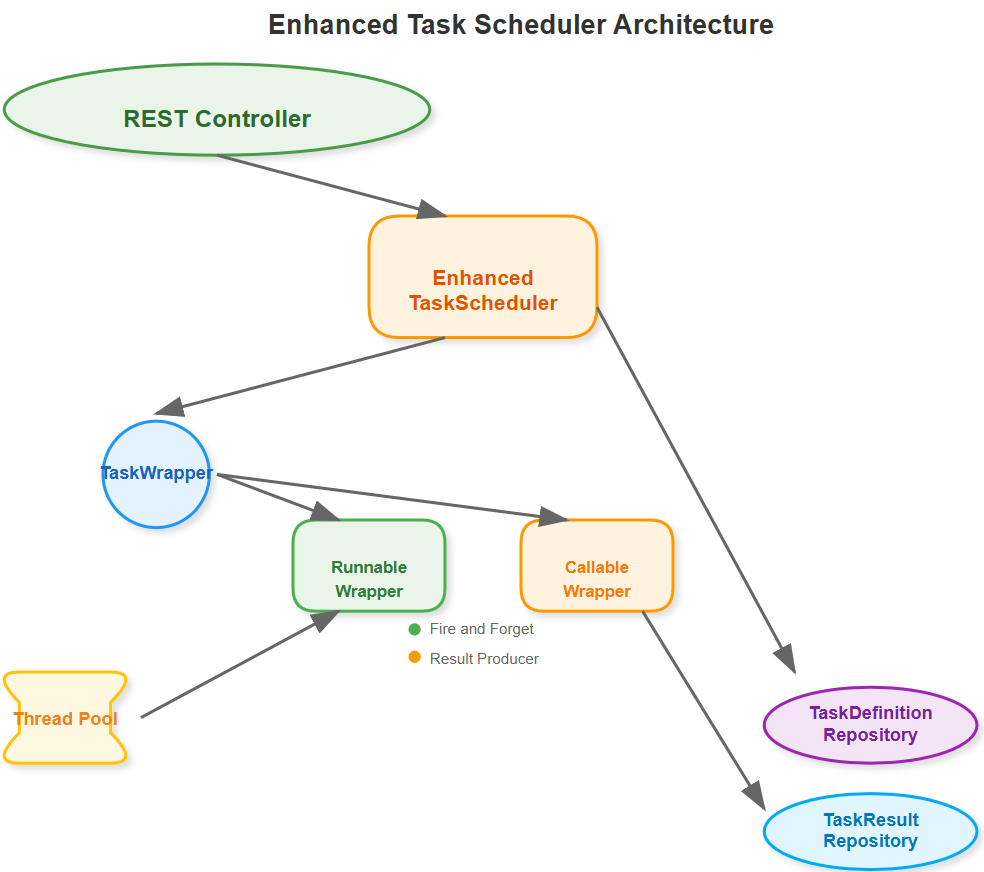
The Problem We're Solving
Modern applications need to handle millions of background tasks - from sending notifications to processing complex calculations. The challenge is building a scheduler that can handle both "fire-and-forget" operations (like email sending) and result-producing computations (like price calculations) efficiently. Today we're refactoring our dynamic scheduler to work with Java's fundamental task execution interfaces, creating the foundation for ultra-scalable distributed systems.
The Building Blocks of Task Execution
Think of your task scheduler as a sophisticated kitchen where different types of recipes (tasks) need different cooking approaches. Some recipes just need to be executed (like boiling water), while others need to return a result (like baking a cake that you'll taste-test). In Java's world, these two fundamental patterns are captured by the Runnable and Callable interfaces.
Today we're refactoring our dynamic scheduler from Day 9 to work with these core Java interfaces, creating a more flexible and industry-standard foundation for our ultra-scalable task scheduler.
Why Runnable and Callable Matter in Real Systems
Major platforms like Netflix's task scheduling infrastructure and Uber's workflow orchestration systems rely heavily on these interfaces. They provide the foundation for everything from processing millions of ride requests to encoding video content for streaming.
Runnable: Perfect for fire-and-forget tasks like sending notifications, logging events, or cleanup operations. These tasks execute but don't return meaningful data.
Callable: Essential for tasks that compute and return results - like calculating pricing algorithms, processing payments, or generating reports that other parts of your system need.
Core Concepts: The Task Execution Patterns
Runnable: The Silent Worker
java
@FunctionalInterface
public interface Runnable {
    void run();
}
Runnable represents tasks that execute without returning values. Think background cleanup, sending emails, or updating cache - operations where you care about the action, not the result.
Callable: The Result Producer
java
@FunctionalInterface
public interface Callable<V> {
    V call() throws Exception;
}
Callable tasks return computed results and can throw checked exceptions. Perfect for calculations, data fetching, or any operation where the outcome matters to subsequent processing.
System Design Concepts
Task Abstraction Layer
Our refactored scheduler introduces a crucial abstraction layer that separates task definition (what to execute) from task execution (how to execute). This follows the Command Pattern from Gang of Four design patterns, enabling powerful features like:
Task Serialization: Store task definitions in databases
Dynamic Dispatch: Route different task types to specialized executors
Result Handling: Process return values differently based on task type
Error Recovery: Apply different retry strategies per task category
Execution Context Management
Real production systems need to track task execution context - who triggered it, when, with what parameters. Our implementation maintains this context while supporting both execution patterns, preparing us for distributed scenarios where context becomes even more critical.
Component Architecture Integration