Day 27: Circuit Breaker Pattern with Resilience4j
Protecting Your Scheduler from Cascading Failures

The Silent System Killer: When External Services Fail
Picture this: Your task scheduler is humming along perfectly, processing thousands of tasks per minute. Then suddenly, your payment gateway starts timing out. Instead of just affecting payment-related tasks, your entire scheduler grinds to a halt because every thread is stuck waiting for the failing service. This cascading failure scenario is exactly what the Circuit Breaker pattern prevents.
Real-world context: Netflix’s entire streaming platform could crash if their recommendation service failed—but it doesn’t, thanks to circuit breakers. Similarly, Uber’s ride matching continues working even when their payment system has issues.
Understanding the Circuit Breaker Pattern
Core Concept
A circuit breaker acts like an electrical circuit breaker in your home. When it detects too many failures (electrical overload), it “opens” the circuit, preventing further damage. In software, it monitors calls to external services and stops making requests when failures exceed a threshold.
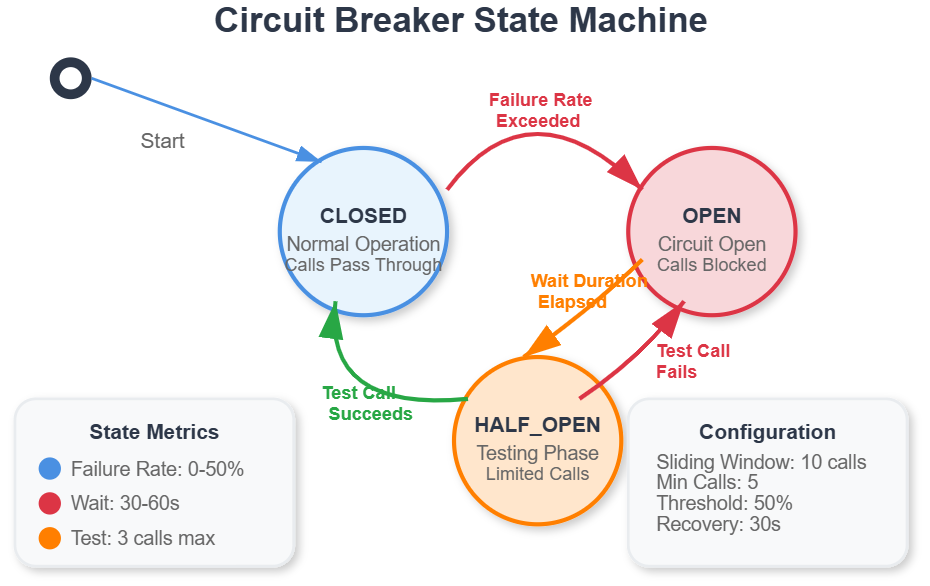
Three Critical States
CLOSED (Normal Operation): All calls pass through to the external service. The circuit breaker tracks success/failure rates.
OPEN (Protection Mode): After failure threshold is reached, the circuit opens. All calls fail immediately without hitting the external service, preventing resource exhaustion.
HALF_OPEN (Recovery Testing): After a timeout period, the circuit allows limited calls through to test if the service has recovered.