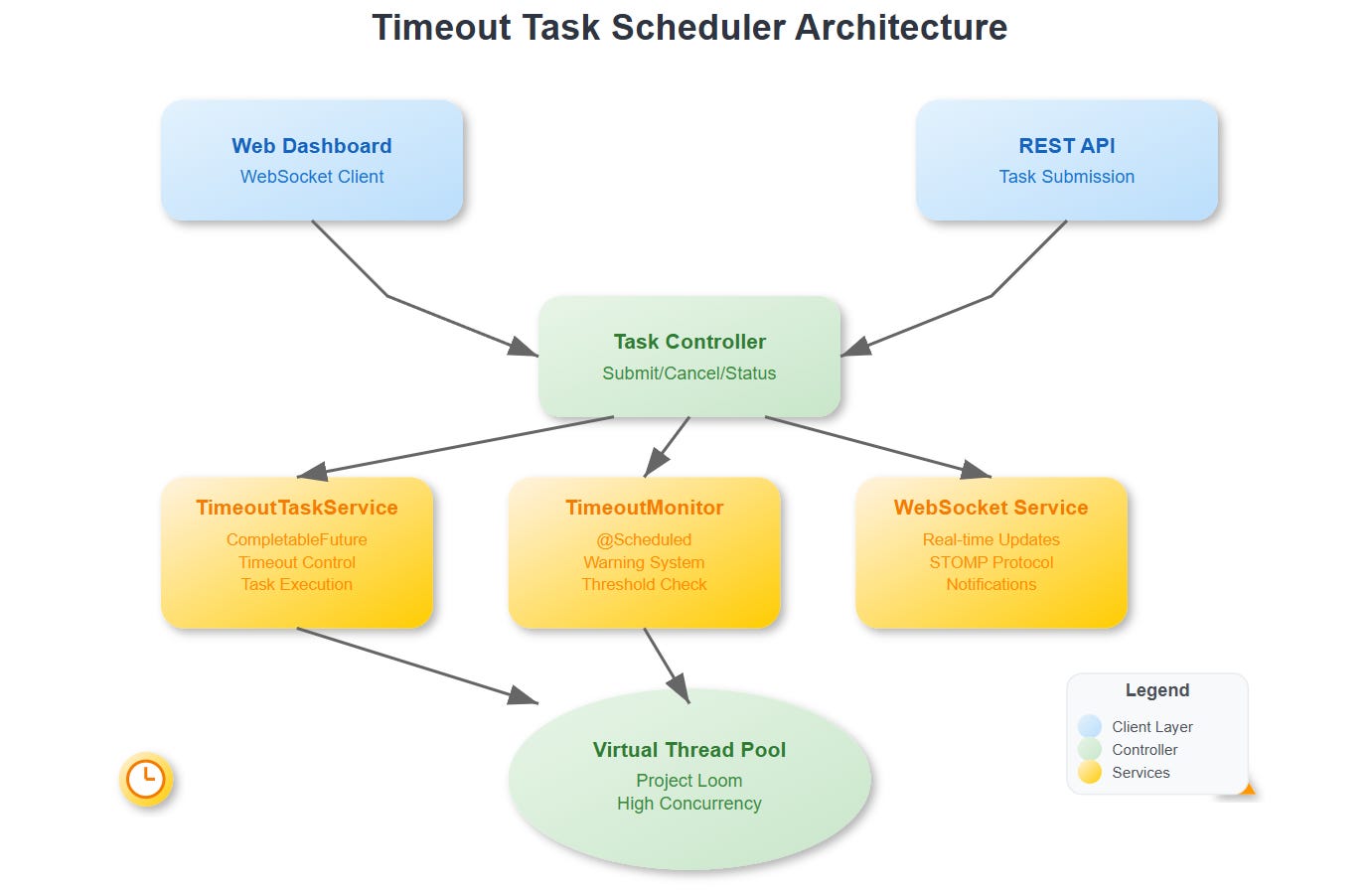
Day 29: Timeout Mechanisms for Tasks
Preventing Resource Exhaustion in Distributed Systems

The Silent Resource Killer
Picture this: You’re Netflix’s backend engineer, and someone submits a video processing task that gets stuck in an infinite loop. Without timeout mechanisms, that single task could consume server resources indefinitely, potentially bringing down your entire video processing pipeline. This isn’t theoretical—major tech companies lose millions annually from runaway tasks that exhaust system resources.
Today, we’re implementing timeout mechanisms that act like smart circuit breakers for your task scheduler. Think of them as vigilant guardians that prevent any single task from monopolizing system resources.
Why Timeout Mechanisms Matter in Production
In yesterday’s lesson, we learned to handle long-running tasks asynchronously using @Async. But what happens when a task doesn’t just run long—it runs forever? Without proper timeout controls, you face:
Resource Starvation: Infinite loops consume CPU cycles indefinitely
Memory Leaks: Tasks that accumulate data without releasing it
Thread Pool Exhaustion: Stuck tasks occupy threads, preventing new tasks from executing
Cascading Failures: One bad task can trigger system-wide performance degradation
Real-world systems like Uber’s ride-matching, Spotify’s playlist generation, or GitHub’s CI/CD pipelines all implement sophisticated timeout mechanisms to prevent these scenarios.
Core Concepts: Future vs CompletableFuture vs ScheduledFuture
Future: The Basic Promise
A Future represents a computation that will complete at some point. It’s like a receipt you get when ordering food—it promises your order will be ready, but doesn’t guarantee when.
Future<String> future = executor.submit(() -> {
    // Some computation
    return “Result”;
});

// This blocks indefinitely if task never completes
String result = future.get(); // Dangerous!
CompletableFuture: The Smart Promise
CompletableFuture adds timeout capabilities and better composition:
CompletableFuture<String> future = CompletableFuture.supplyAsync(() -> {
    // Long-running computation
    return processData();
});

// Timeout after 5 seconds
String result = future.get(5, TimeUnit.SECONDS); // Safe!
ScheduledFuture: The Timed Promise
ScheduledFuture excels at time-based operations and cancellation:
ScheduledExecutorService scheduler = Executors.newScheduledThreadPool(1);
ScheduledFuture<?> future = scheduler.schedule(() -> {
    // Task logic
}, 10, TimeUnit.SECONDS);

// Cancel if still running after timeout
future.cancel(true);
Architecture Integration: Building on Previous Lessons